
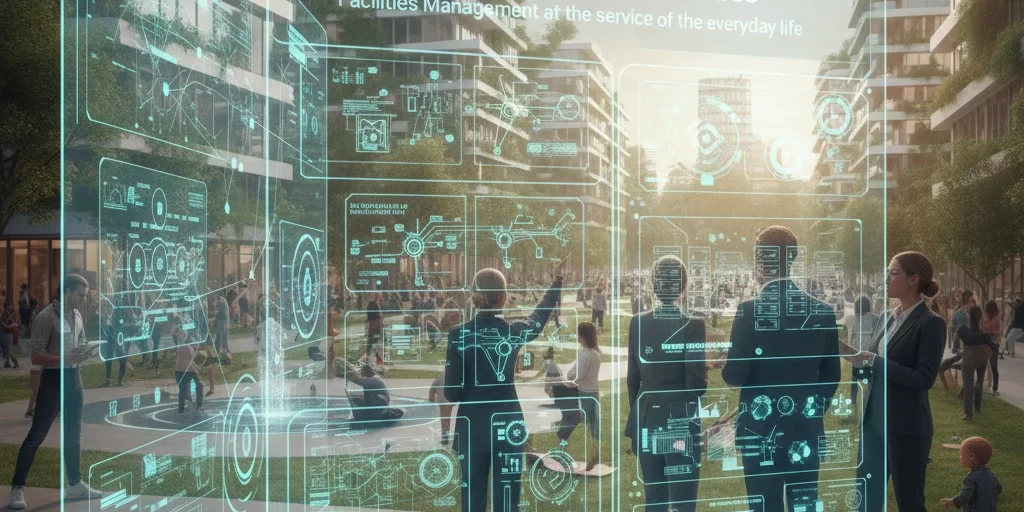
In a world where everything happens simultaneously, time has become the most valuable commodity.
From businesses striving to serve more clients, to professionals juggling countless responsibilities, speed is no longer just a competitive advantage; it is a matter of survival.
Every second counts. Every decision can determine the success or failure of an entire operation. And within this landscape, Facilities Management is evolving into an essential strategic mechanism that enables organizations to remain functional, efficient, and agile.
The pace of our era
At the core of this new reality, where delays are unforgivable, data changes every second, and decisions must be made in real time, lies the need for organizations that operate with flexibility, foresight, and speed, without sacrificing stability, accuracy, or quality.
Speed does not mean haste. It means structure, planning, and technology that supports immediate, error-free action.
From facility operations and technical coordination to customer support and energy management, every minute is a critical resource.
As an integrated organizational system, Facilities Management allows businesses to anticipate, prevent, and perform with consistency and reliability.
Technology as an accelerator
Automation systems, cloud infrastructures, IoT sensors, and predictive analytics have transformed the way facilities operate.
From smart lighting and energy dashboards to computerized maintenance systems (CMMs), technology has moved from theory to full implementation, and decisions are no longer based on instinct but on real-time data.
Information arrives faster, systems become automated, errors decrease, and maintenance shifts from reactive to preventive.
Yet technology alone is not enough.
We need people who understand the importance of timing, professionals who know when to slow down, when to accelerate, and when to innovate.
Human intelligence, combined with digital insight, is ultimately what allows a smart building to operate like a living organism.
The new luxury
We increasingly understand that real luxury today is not money or ownership, it is the ability to control time, to anticipate, to avoid delays, and to live or work at a pace that serves you rather than overwhelms you.
For an organization, proper time management translates into operational resilience.
Prevention replaces repair, precision reduces cost, and predictability strengthens reliability.
Businesses that embrace this philosophy become more flexible, humane, and efficient, able to function without interruptions, losses, or energy waste.
In this context, speed becomes a tool for growth and a new way of understanding effectiveness based on accuracy, trust, and transparency.
Facilities Management in the era of seconds
In this era of seconds, Facilities Management is the nervous system of modern businesses and cities. A mechanism that coordinates people, technology, and operations into a unified, efficient, and sustainable framework.
A new form of professional maturity, where technology serves the human and the human guides the technology.